
“RAMA TO THE RESCUE” is a lesson from the Textbook“POORVI” approved by NCERT for the Students of Class 6. Here all the Textual Questions are answered by English teachers.
Let us do these activities before we read.
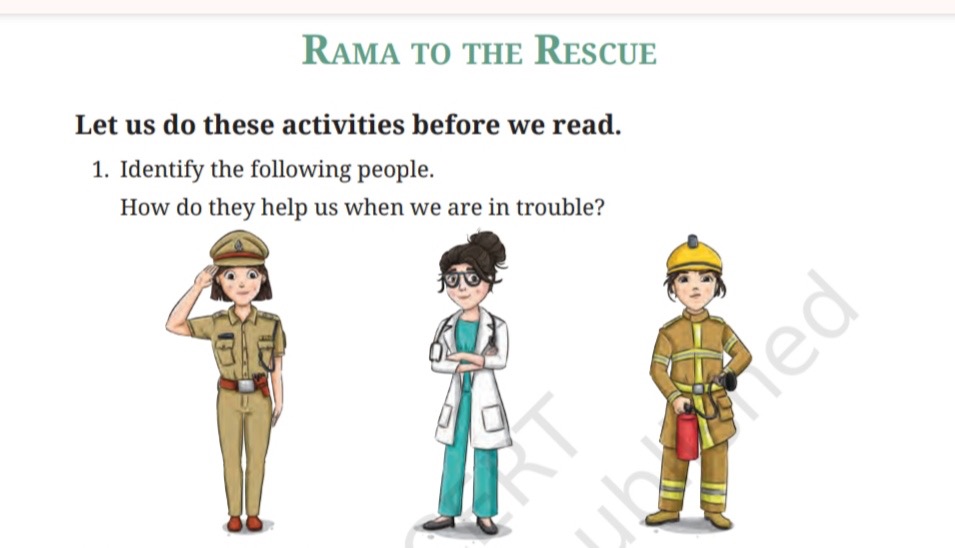
1. Identify the following people.
How do they help us when we are in trouble?
Answer:
The Police help to keep the people and their property safe.
The Doctor helps to keep our health in check.
The fire brigade extinguishes the fires that catch our property.
2. Choose the correct option to complete the sentence.
The word ‘rescue’ means to _________________
(a) make fun of someone
(b) save someone
(c) ask someone for help
Answer: The word ‘rescue’ means to – save someone.
3. Work in pairs.
Put a tick mark at the end of the phrases describing those who need to be rescued. Share your answers with your teacher and classmates.
(a) A man stuck in a building on fire. [ ]
Answer: A man stuck in a building on fire.[ ✓ ]
(b) A woman buying vegetables in the market. [ ]
Answer: A woman buying vegetables in the market.[ × ]
(c) A dog who has hurt its leg. [ ]
Answer: A dog who has hurt its leg.[ ✓ ]
(d) A tree being cut down in a forest. [ ]
Answer: A tree being cut down in a forest. [ ✓ ]
4. The policeman in the story you are about to read is called the kotwal. Some people call him thaanedar. What do you call a policeman in your language? Share it with your classmates and teacher.
Answer: We call a policeman ‘police’ in our language.
5. Imagine you are alone at home and you face a problem. Answer the following questions and share your answers with your teacher and classmates.
(a) Will you solve the problem yourself or wait for someone to help you?
Answer: I shall solve the problem myself. If I can’t solve it, I will seek someone to help me.
(b) How will you deal with the problem? Give a reason.
(i) Be worried about the problem and give up.
(ii) Feel angry that only you have the problem.
(iii) Think quickly about ways to solve the problem.
Answer: I shall think quickly about ways to solve the problem.
Let us discuss
Circle the odd one-
1. The characters are: husband, wife, children
Answer: Children
2. Who entered the house?: guest, robber, Kotwal
Answer: robber.
Let us discuss
Write whether True or False.
1. The man tells his plan to his wife. [ ]
Answer: The man tells his plan to his wife.[ True ]
2. The thief wants to know where they kept their jewels. [ ]
Answer: The thief wants to know where they kept their jewels. [ False ]
Let us discuss
1. Along with your classmates, call out the name ‘Rama’- softly, loudly and very loudly.
Answer: Students call out loudly ‘Rama’.
2. What do you think will happen next in the story?
Answer: I think Rama, the Kotwal, will hear his name and catch the thief.
Let us discuss
1. Work in pairs to match the words in Column A with the meanings in Column B. Check your answers by sharing them with your teacher and classmates.
| Column A | Column B |
| 1. wonder | (a) in place of someone or something |
| 2. yard | (b) carefully |
| 3. Chatter | (c) an area outside a building |
| 4. instead | (d) talk for a long time about unimportant things |
| 5. closely | (e) maybe |
| 6. perhaps | (f) a feeling of surprise |
Answer:
| Column A | Column B |
| 1. wonder | (f) a feeling of surprise |
| 2. yard | (c) an area outside a building |
| 3. Chatter | (d) talk for a long time about unimportant things |
| 4. instead | (a) in place of someone or something |
| 5. closely | (b) carefully |
| 6. perhaps | (e) maybe |
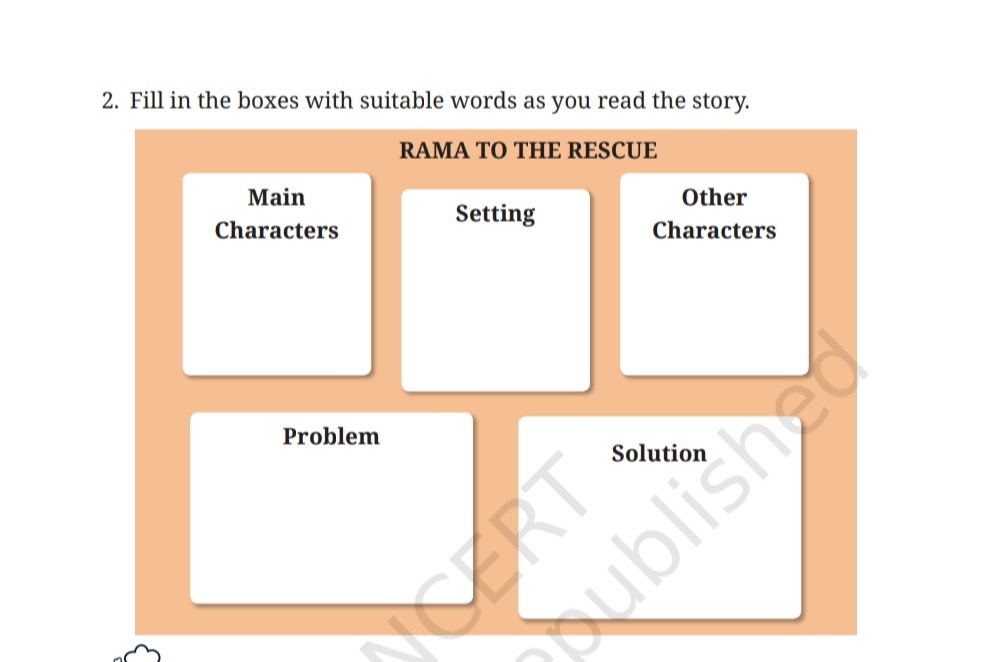
2. Fill in the boxes with suitable words as you read the story.
Answer:
Main Characters: Man and his wife, Rama
Setting: in a village
Other Characters: thief
Problem: The thief was trying to find out the location of the money to steal it.
Solution: The wife started calling out Rama, the village Kotwal’s name. He heard his name and caught the thief.
Let us think and reflect
1. Read the following lines and then answer the questions that follow.
(a) Man: What’s the matter? What are you looking at?
Wife: Ssssh! Listen!
Man: Somebody is trying to get in.
Wife: I… I think he has got in… the noise has stopped.
(i) What makes the man say the first line?
Answer: He notices that his wife’s behavior has changed and she is focused on something alarming.
(ii) Choose the correct option.
The wife says ‘Ssssh! Listen!’. What does the word ‘Ssssh’ mean here?
a. sleep
b. help
c. rest
d. be silent
Answer: The word ‘Ssssh’ means – be silent.
(iii) How can you tell that the wife was listening carefully?
Answer: The wife’s concern about the incident proves the fact that she was listening carefully.
(b) Rama, the village kotwal, ran to the house from which he heard his name being called.
Rama: Oh, Oh! Some thief has dug his way into this house.
(i) Fill in the blank with the correct word from the given lines.
The villagers caught the thief and took him to the
___________ .
Answer: The villagers caught the thief and took him to the police station.
(ii) Choose the correct option.
What do the words “Oh, Oh!” show here?
a. surprise
b. anger
c. pain
d. happiness
Answer: Here the word “Oh, Oh!” shows – surprise.
(iii) How can you tell that the kotwal was good at his job?
Answer: When the wife calls out Kotwal’s name, he runs towards her home, only to find that a thief has dug his way into their home. The Kotwal then caught the thief and was quick to take action against the thief.
2. Give one reason why the man and his wife were not able to fall asleep.
Answer: The man and his wife didn’t sleep because they knew that a thief had dug out a way into their home.
3. What did the thief wish would happen? Did it happen?
Answer: Thief wishes that they talk about their money or they fall asleep. No, it did not happen.
4. How did the man and his wife get help from the kotwal?
Answer: Rama, the Kotwal ran towards their home, only to find that a thief had dug out his way into their home. He caught the thief and took him to the police station.
5. Do you think cleverness can help us solve our problems? Why do you say so?
Answer: Yes, it was her husband’s cleverness that the thief didn’t doubt their conversation, and they saved themselves.
Let us learn
1. Study the highlighted words in the following lines.
- I’m feeling so sleepy…
- It’s a thief.
- They’re awake.
The highlighted words given in the above sentences have one letter missing in each. What are they? Share them with your teacher and classmates.
Now, write the full words with the missing letter.
(a) _________ feeling so sleepy….
Answer: I am feeling so sleepy….
(b) _________ a thief.
Answer: It is a thief.
(c) ___________ awake.
Answer: They are awake.
2. Expand the following words. Two examples have been done for you.
Use the contracted form of these words in sentences of your own.
| S. No. | Contracted Words | Expanded Form | Sentences |
| (a) | what’s | what is | |
| (b) | I’ll | ||
| (c) | I’d | ||
| (d) | we’ll | ||
| (e) | that’s | ||
| (f) | we’re | ||
| (g) | don’t | ||
| (h) | you’ll | ||
| (i) | must’ve | must have |
Answer:
| S. No. | Contracted Words | Expanded Form | Sentences |
| (a) | what’s | what is | What’s your name? |
| (b) | I’ll | I will | I’ll do it tomorrow. |
| (c) | I’d | I would | I’d go with you. |
| (d) | we’ll | We will | We’ll go together. |
| (e) | that’s | That is | That’s a beautiful picture. |
| (f) | we’re | We are | We’re playing football. |
| (g) | don’t | Do not | I don’t like spicy food. |
| (h) | you’ll | You will | You’ll enjoy the movie. |
| (i) | must’ve | must have | She must’ve forgotten her keys at home |
3. Study the highlighted words and the words in the brackets in the following sentences from the story.
(a) I am feeling so sleepy. [am + feel + ing]
(b) What are you looking at? [are + look + ing]
(c) Somebody is trying to get in. [is + try + ing]
(d) They are saying something. [are + say + ing]
(e) Perhaps, they are talking about their money. [are talking]
Now, choose the correct option.
The sentences (a)-(e) refer to actions that ___________ .
[are going on at the time of speaking/happened in the past/will take place in the future]
Verbs that describe what someone or something is doing at the moment of speaking are in the present progressive tense.
4. Fill in the blanks to complete the following sentences.
(a) I _________ in Grade 6. [am + study + ing]
Answer: I am studying in Grade 6.
(b) My friend ____________ a story book. [is + read + ing]
Answer: My friend is reading a story book.
(c) We ____________ a board game. [are + play + ing]
Answer: We are playing a board game.
(d) I __________ a new language. [am + learn + ing]
Answer: I am learning a new language.
(e) The teachers ____________ in the staff room. [are + sit + ing]
Answer: The teachers are sitting in the staff room.
(f) My mother ___________ food in the kitchen. [is + cook + ing]
Answer: My mother is cooking food in the kitchen.
5. Study the following picture and fill in the blanks with the present progressive form of verbs.
(a) Govind and Anu _________ football.
Answer: Govind and Anu are playing football.
(b) Pema __________ flowers.
Answer: Pema is touching flowers.
(c) Anil ____________ the score card.
Answer: Anil is holding the score card.
(d) The mother ___________ a book.
Answer: The mother is reading a book.
(e) The dog ___________ to catch the ball.
Answer: The dog is trying to catch the ball.
(f) The birds ___________ in the sky.
Answer: The birds are flying in the sky.
6. Study the following sentences from the story and complete the table. One example has been done for you.
(a) I’d better listen closely.
(b) When he’s in the house, I’ll call out softly to him.
(c) Then I’ll call out very loudly…
| S. No. | Sentence | Question | Word |
| 1. | I’d better listen closely. | How does he listen? | a. closely |
| 2. | When he’s in the house, I’ll call out softly to him. | How does she call out? | b. |
| 3. | Then I’ll call out very loudly. | How does she call out? | c. |
Answer:
| S. No. | Sentence | Question | Word |
| 1. | I’d better listen closely. | How does he listen? | a. closely |
| 2. | When he’s in the house, I’ll call out softly to him. | How does she call out? | b. Softly |
| 3. | Then I’ll call out very loudly. | How does she call out? | c. very loudly |
| Words that give more information about the verb, such as how, when, where, etc. are called adverbs. |
7. Fill in the blanks with suitable adverbs from the box given below. There are two extra words that you do not need.
| warmly gracefully smoothly beautifully funnily quickly hurriedly |
(a) He solved the mathematics problem __________ .
Answer: He solved the mathematics problem quickly.
(b) The car moved ___________ along the highway.
Answer: The car moved smoothly along the highway.
(c) The musician played the guitar _____________.
Answer: The musician played the guitar beautifully.
(d) Shobha danced _____________.
Answer: Shobha danced gracefully.
(e) Rohit left the house _____________.
Answer: Rohit left the house hurriedly.
8. Fill in the blanks with suitable adverbs from the box given below. There are two extra words that you do not need.
| honestly brightly peacefully sweetly angrily slowly tirelessly |
Once upon a time in a small forest, animals lived (i) __________ . The wise old tortoise moved (ii) __________ but always won the race against the proud rabbit. The ants worked (iii) __________ , gathering food for the winter. The kind-hearted lion ruled the jungle (iv) __________, giving everyone a chance to speak. The birds sang (v) ___________ , making everyone in the forest happy.
Answer:
Once upon a time in a small forest, animals lived (i) peacefully . The wise old tortoise moved (ii) slowly but always won the race against the proud rabbit. The ants worked (iii) tirelessly , gathering food for the winter. The kind-hearted lion ruled the jungle (iv) honestly, giving everyone a chance to speak. The birds sang (v) sweetly , making everyone in the forest happy.
9. Study the following sentences from the story and choose the correct option.
(i) Oh, hum! What a hard day it has been!
(ii) Ah, at last, they’ve stopped their chatter!
(iii) What should we do?
(iv) What should we name our child?
a. Sentence (i) expresses a feeling of ___________ (tiredness/joy)
Answer: Sentence (i) expresses a feeling of tiredness.
b. Sentence (ii) expresses a feeling of ___________ (wonder/relief)
Answer: Sentence (ii) expresses a feeling of relief.
c. Sentences (iii) and (iv) ask _____________ (answers/questions)
Answer: Sentences (iii) and (iv) ask questions.
10. Punctuate the following sentences and write whether they are exclamatory or interrogative sentences.
(a) Wow, what an intelligent man he is
Answer: exclamatory sentence.
(b) Oh how big the hole is
Answer: exclamatory sentence.
(c) Do you like to read comic books
Answer: interrogative sentence.
(d) What is your favourite story
Answer: interrogative sentence.
Let us listen
You will listen to a security guard making an announcement to the people in the neighbourhood. As you listen, fill in the blanks with only one word that you hear. (refer to page 38 for transcript)
The security guard announced that (i) ________ has been happening in that area. He advised everyone to stay safe and the kids to tell the (ii) ___________ as soon as they find anything different. They should not forget that (iii) ____________ is the main thing. He asked them to call (iv) ____________ when they need immediate help.
Answer:
The security guard announced that (i) robbery has been happening in that area. He advised everyone to stay safe and the kids to tell the (ii) adults as soon as they find anything different. They should not forget that (iii) safety is the main thing. He asked them to call (iv) 100 when they need immediate help.
Let us speak
1. Listen to your teacher pronounce the contractions and repeat after your teacher.
| I’ll it’s that’s we’ll don’t I’m I’dthey’re you’re we’re he’s what’s |
| We use contracted form of the verbs while speaking and expanded form of the verbs while writing. |
Now, speak these contractions clearly along with your teacher and classmates.
| can’t won’t I’ve wouldn’t shouldn’t didn’t |
2. Discuss in pairs:
(a) Why do you think it’s important for people to keep their house and themselves safe? Tick the suitable reasons.
(i) To be safe from injury [ ]
(ii) To keep family members and pets safe [ ]
(iii) To stop accidents from happening [ ]
(iv) To make sure they visit the doctor regularly [ ]
(v) To stop robbery [ ]
(vi) To pay the electricity [ ]
(vii) To save money [ ]
Answer:
(i) To be safe from injury [ ✓ ]
(ii) To keep family members and pets safe [ ✓ ]
(iii) To stop accidents from happening [ ✓ ]
(iv) To make sure they visit the doctor regularly [ X ]
(v) To stop robbery [ ✓ ]
(vi) To pay the electricity [ X ]
(vii) To save money [ X ]
(b) Now, use the given hints to share your reasons in complete sentences with your teacher and classmates.
- I think it’s important because…/
- I feel it’s necessary as…/
- The reason we need to look at safety is….
Answer:
- I think it’s important because being safe from injury ensures that no one gets hurt and can live a healthy life.
- I feel it’s necessary as keeping family members and pets safe is a priority for everyone.
- The reason we need to look at safety is to stop accidents from happening, which can cause harm and inconvenience.
- It’s also essential because preventing robbery protects our valuable possessions and keeps us feeling secure.
- Additionally, safety measures can help us save money by avoiding medical bills and repair costs from accidents.
(c) Use the given hints to share three ideas on how people can keep their houses and themselves safe. Share with your classmates and teachers.
- I think they should…/
- I suppose they could…/
- They must…/
- They should…/
- How about…/
- It might be better to …
Answer:
- I think they should install security cameras and alarm systems to deter burglars and monitor their property.
- I suppose they could keep their doors and windows locked, especially when they are not at home.
- They must create an emergency plan for situations like fires, ensuring everyone knows what to do.
- They should regularly check and maintain smoke detectors and fire extinguishers in the house.
- How about educating family members, especially children, about safety measures and emergency contacts?
- It might be better to keep a first-aid kit and emergency supplies in an easily accessible place.
Let us write
The next day, the neighbour asked the man in the story about what had happened. As the man, tell the neighbour what had happened in your own words. Remember to include the following:
when …………………………………….
where ……………………………………..
what ………………………………………
how ………………………………………..
why ………………………………………..
You may begin this way:
My wife and I were about to go to sleep last night when we heard someone…
Answer: My wife and I were about to sleep last night when we heard some noises at home. When I looked, I saw that a thief had entered our home. I told my wife to lie down and do what I said. We started a conversation about our future child’s name. I told her our son’s name would be Rama. I continued to extend the area our child would be, from our home to our village street, in the pretext of calling out Rama, the kotwal of our village, without letting the thief doubt us. Eventually, Rama heard her scream and arrested the thief.
Let us explore:
1. Find out from your teacher or parents what you would do in the following situations.
Who will you call if…
- you see fire
Answer: Call the fire department.
- you see someone getting hurt
Answer: Take him to a nearby hospital.
- you see a wounded animal
Answer: Call/contact a local Animal Control or a nearby Animal Shelter.
- you see someone suspicious
Answer: Call the police/contact an adult.
- you find a lost child
Answer: Take him to a nearby police station.
- you get lost
Answer: Go to a police station and call your parents.
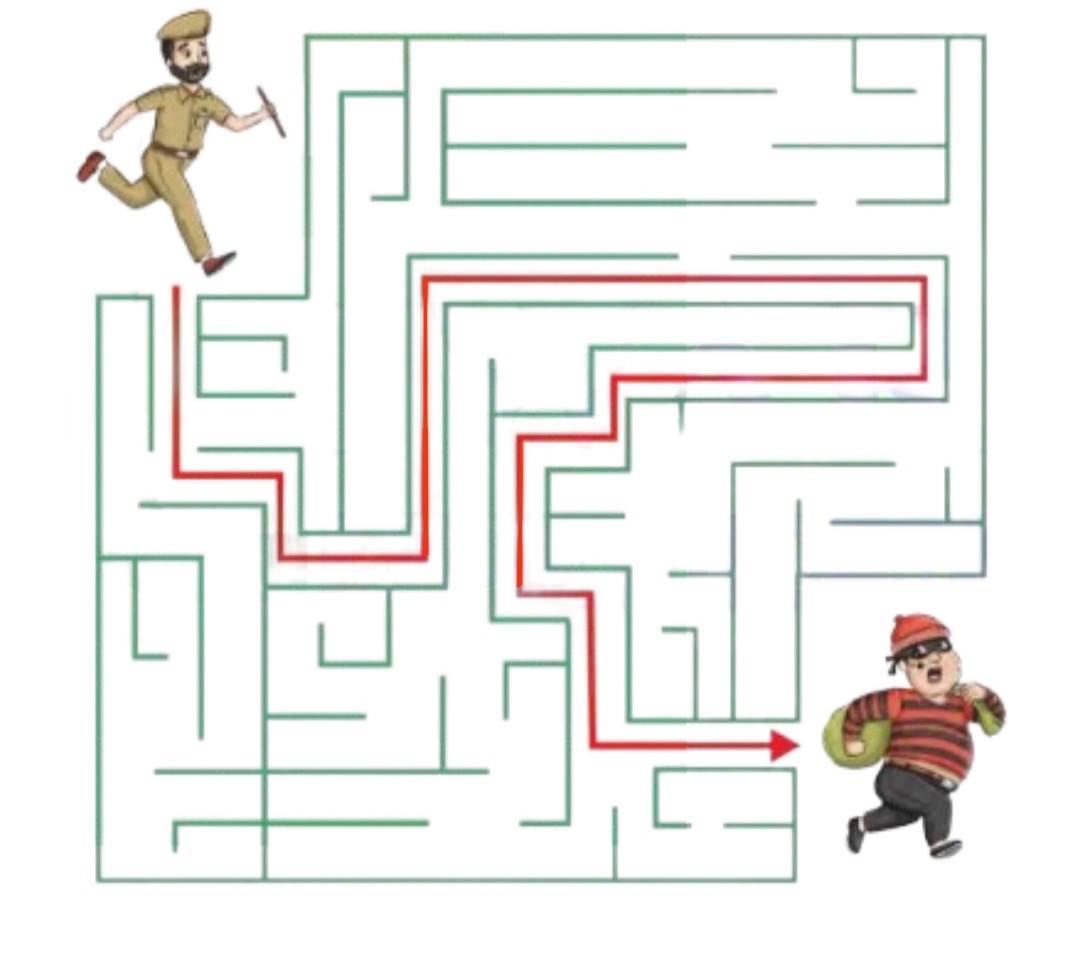
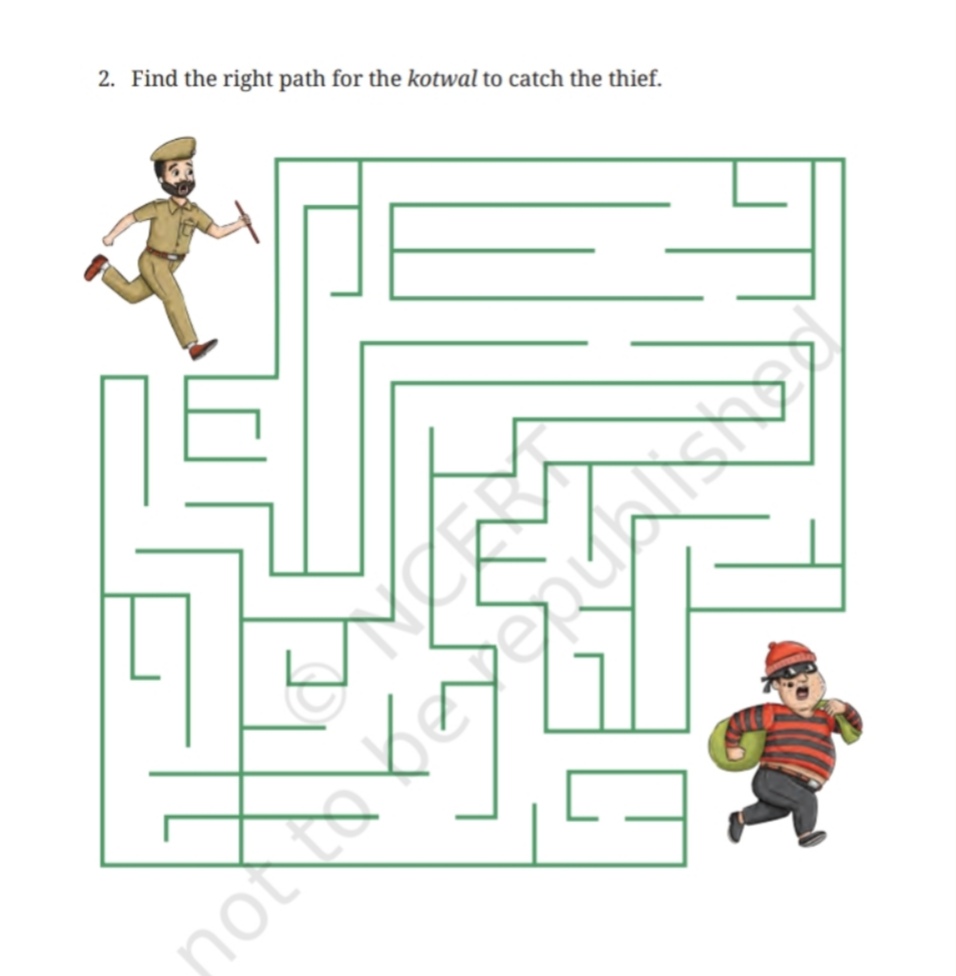
2. Find the right path for the kotwal to catch the thief.
Answer: